
Astrology, Birth Charts and Symbolic Exploration
Explore birth charts, timing, relationships, tarot, and celestial creativity in approachable language.
A warm, grounded path through symbolic language
Astrology can feel like a sky full of unfamiliar symbols, especially when a single placement is presented as though it explains everything. This publication takes a wider, gentler view. It explores charts as layered maps of signs, planets, houses, aspects, and timing, while keeping the language clear enough to follow without flattening the mystery that makes symbolism compelling.
Begin with the question that brought you here. You might be trying to understand a birth-chart pattern, make sense of a changing season, notice how two people activate one another, or find words for an image that keeps returning. The purpose is not to hand you a fixed verdict. It is to offer useful concepts, distinctions, and prompts for noticing what resonates in real life.
Birth-chart coverage builds from basic architecture toward richer interpretation: what houses describe, how signs shape expression, why birth time matters, and how planets relate through aspects. Rather than isolating one feature, these guides encourage you to place it back inside the whole chart. Context is often where a familiar label becomes a more personal, specific, and nuanced reflection.
Timing and relationship topics bring motion into the picture. Transits can be approached as symbolic weather to observe, record, and consider, not commands or guaranteed predictions. Synastry can illuminate chemistry, friction, pacing, and shared patterns without reducing a relationship to one dramatic aspect. These subjects become most useful when curiosity has room to coexist with communication, judgment, and lived experience.
Tarot, zodiac symbolism, and reflective practice offer other ways to slow down and look closely. A card image, elemental pattern, lunar phase, or journal page can become a frame for a better question. This publication treats these traditions as interpretive tools rather than scientifically established methods of prediction, leaving room for wonder while staying honest about what symbolism can and cannot establish.
Latest explorations

Zodiac Decans: What They Add to Sun-Sign Interpretation
Each zodiac sign contains three 10-degree decans. Discover how these smaller divisions add nuance to Sun signs, planets, angles, and chart…
Read more
Empty Houses in Astrology: Why an Empty House Is Not a Missing Life Area
Empty houses are normal in a birth chart. Their life themes still matter; the key is to read the sign on…
Read more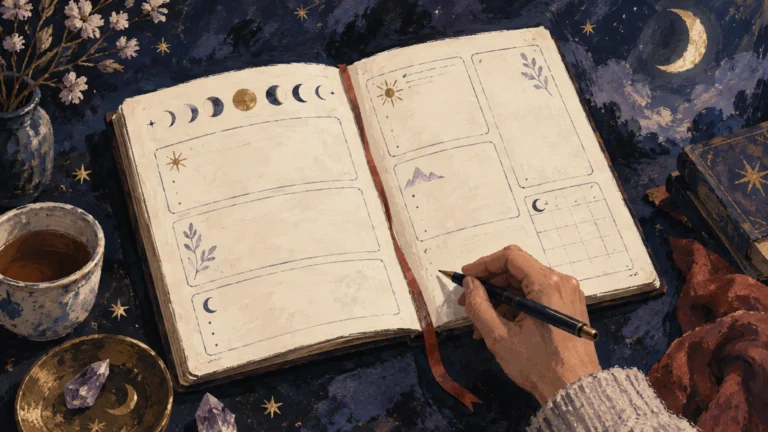
How to Build a Monthly Astrology Reflection Page
Build a monthly astrology reflection page that gives celestial timing, real-life observations, and personal meaning their own clear spaces.
Read moreBring celestial ideas into everyday form
Symbolism does not have to remain abstract. Celestial design coverage follows the moment when an idea becomes a color palette, constellation motif, chart-inspired composition, moon-phase marker, or tactile paper project. The focus is on choices that make meaning visible: what to simplify, which details deserve attention, and how to keep a design expressive without letting every star, glyph, and shimmer compete at once.
Practical considerations can sharpen rather than diminish the magic. Scale, contrast, hierarchy, and legibility determine whether a motif feels intentional or simply crowded. Thoughtful design coverage helps readers balance atmosphere with clarity, whether they are collecting visual references, arranging a journal spread, or turning a favorite celestial symbol into something tangible. A limited palette or a well-placed detail can carry remarkable feeling.
Weddings and events create a particularly rich setting for this work. Astrology can inform an invitation suite, celebration theme, birthday detail, or personal keepsake without overwhelming the practical information guests need. Coverage considers wording, visual hierarchy, symbols, materials, and atmosphere so celestial references feel personal and coherent. The aim is not to prescribe one cosmic aesthetic, but to help readers translate significance into a visual language that feels like their own.
Journaling offers a quieter version of the same process. A useful page can separate dates and observable events from feelings, associations, and later interpretation. That structure makes it easier to revisit an impression without unconsciously rewriting the memory around it. Prompts and page ideas support attention, pattern recognition, and reflection while allowing uncertainty to remain an honest part of the record.
As you explore, move between broad guides and specific questions. Start with foundational chart language if the vocabulary feels dense; choose timing or synastry when context matters; turn to tarot and journaling when imagery or reflection feels more natural; visit design and event topics when you want to make symbolism tangible. The most meaningful interpretation is rarely the loudest or most absolute. It is the one that helps you notice, compare, create, and return with better questions.